Bhargav Shah
Sep 22, 2026

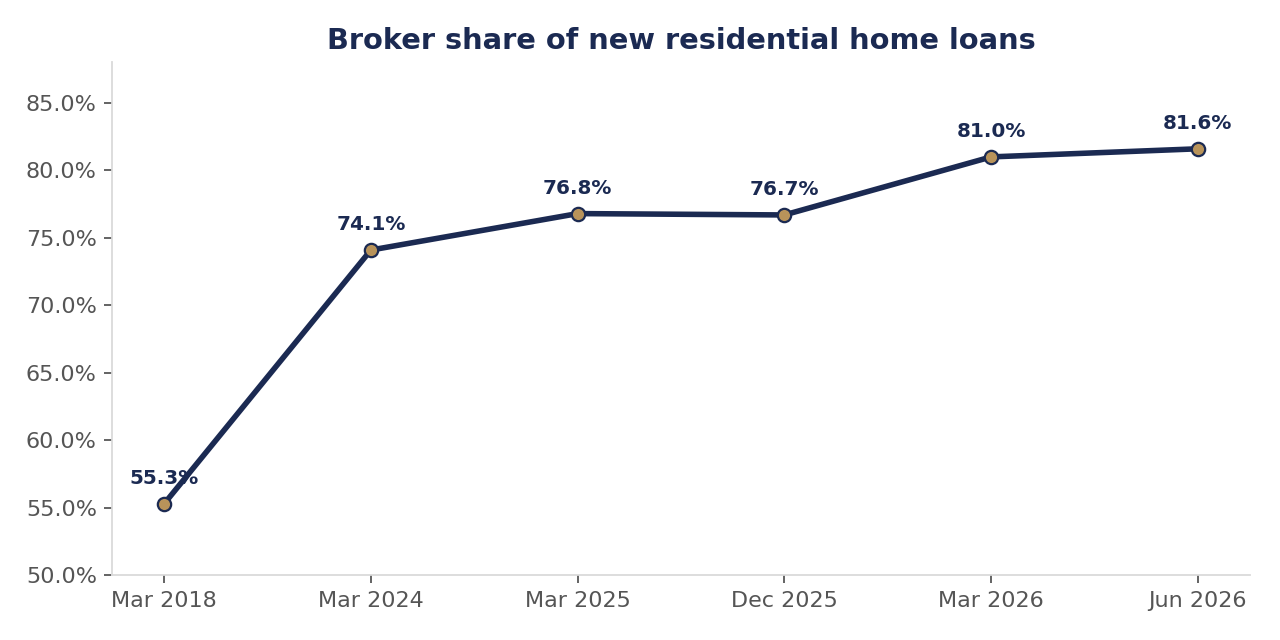
According to MFAA data compiled by Cotality, mortgage brokers arranged a record 81.6 percent of Australia's new residential home loans in the June 2026 quarter, up four percentage points in a single year. In dollar terms, that was 139.08 billion dollars of new lending settled through the broker channel in ninety days, the largest June quarter on record.
Eight years ago the split was close to even. In March 2018 brokers held 55.3 percent. The channel has added 26 percentage points of market share since, quarter after quarter, through a royal commission, a pandemic, thirteen rate rises and a housing affordability crisis. Whatever was supposed to slow it down did not.
Australia now sits alongside the United Kingdom and the Netherlands as one of only three countries where brokers facilitate more than 80 percent of mortgage lending. The MFAA's explanation is straightforward: lending got complicated, and borrowers wanted a professional in their corner.
The evidence supports it. APRA's new debt to income cap means a borrower can pass one bank's servicing test and still be declined on quota. Government schemes for first home buyers vary by state and change constantly. Fixed and variable pricing moves weekly as lenders fight over a competitive market. A direct channel asks the customer to navigate all of that alone. A broker does not.
Remember the context in which this run began. The 2018 royal commission put broker remuneration under a microscope, lenders rebuilt commission models, and a best interests duty was legislated for brokers, a standard bank branch staff still do not carry. Plenty of commentators predicted the channel would shrink under the weight of its new obligations.
The opposite happened, and the reason is instructive. Regulation did not make broking less attractive. It made broking more trustworthy, at exactly the moment lending complexity made professional help more necessary. A borrower choosing between a channel legally obliged to act in their best interests and a channel that is not was never going to be a close contest once the difference was understood.
There is also a scale effect at work. The MFAA counted more than 22,000 brokers by late 2024, a record, and the network keeps deepening its reach into commercial lending, asset finance and specialist niches. Every year the channel can serve more of a borrower's financial life, and every year the case for walking into a branch weakens a little further.
Market share is leverage. At 55 percent, broking was a channel banks tolerated. At 81 percent, it is the distribution system of Australian housing finance, and that changes the conversation on commissions, turnaround service standards and technology investment. Lenders now compete for broker attention the way they once competed for branch traffic.
It also raises the stakes on capacity. Every point of share is thousands of additional files flowing into broking businesses that are, on average, small. The channel won the volume. The next five years decide whether it can process what it won, at the standard regulators and clients now expect. The firms investing in process, people and governance today are the ones that keep the share everyone else fought to win.

.png)



.png)
.png)
.svg)