Bhargav Shah
Oct 09, 2026

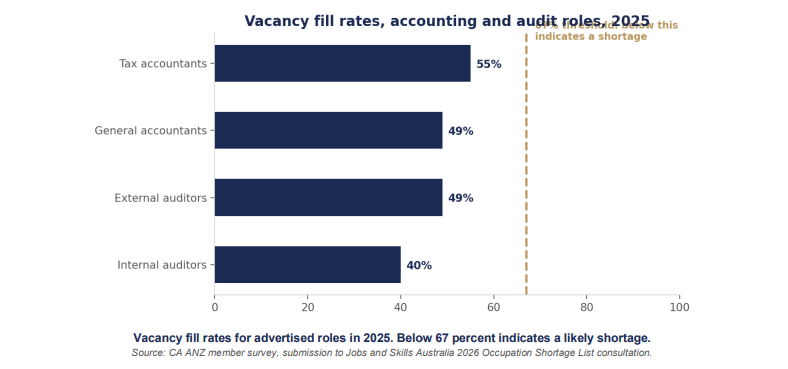
CA ANZ surveyed members who advertised vacancies through 2025 as part of the Jobs and Skills Australia consultation, using the official methodology where a fill rate below 67 percent indicates a likely shortage. The results: internal auditor roles filled at 40 percent, external auditors at 49 percent, general accountants at 49 percent and tax accountants at 55 percent. Every core occupation sits well under the line, and CA ANZ has recommended a national shortage rating across the board
The demand side keeps compounding. CA ANZ and industry estimates put demand for accounting, audit and finance roles at approximately 28,000 positions by 2029, with a projected shortfall of around 6,000 accountants by 2030. Australian Bureau of Statistics projections suggested the profession needed a workforce of roughly 338,000 by 2026, a level the market has not met.
Supply is the uglier half of the story. Graduate completions in accounting have fallen 19 percent.
Enrolments in the accounting Professional Year program dropped from 7,122 in 2018 to around 340 in
2024, a fall of about 95 percent. Meanwhile roughly 22,000 accountants were expected to retire by 2026,
taking decades of technical knowledge and client relationships with them.
This is not a cyclical squeeze that a good graduate intake fixes. The people who would have entered the profession five years ago simply do not exist in the pipeline, and the training lag means nothing done today produces a senior accountant before 2030.
A shortage never stays contained inside the recruitment budget. Job advertisement data tracked by Jobs and Skills Australia showed accounting roles posted rising 24.5 percent annually since 2023, and every unfilled seat converts directly into salary pressure on the next hire and counteroffers for the people already on the team. Practices report offers being accepted and then abandoned when a rival adds ten percent, sometimes between contract and start date.
The costlier effect is quieter. When a role sits open, the work does not wait. It rolls uphill to the most expensive people in the firm, so partners review less and produce more, seniors do work a graduate should own, turnaround stretches and review quality thins exactly when error risk is rising. Burnout follows, and burnout resigns, which reopens the vacancy that started the cycle.
That is the real cost of the shortage: not the recruiter's fee, but margin quietly bleeding out through misallocated senior hours. Any response that does not put hours back into the top of the firm, whether through automation, role redesign or structured support capacity, is treating the symptom and feeding the cause.
The uncomfortable conclusion for practice owners is that the constraint has moved permanently outside the recruitment process. If a firm's growth plan depends on finding the perfect local hire every time work picks up, delivery is tied to a market the firm does not control, and that market just posted fill rates of 40 to 55 percent.
The firms growing through the shortage have restructured the work instead: automating the mechanical layer, redesigning roles so scarce senior people spend hours only where judgment is required, and building structured additional capacity, including governed offshore teams, for everything else. The talent crisis is real. The capacity crisis is optional.

.png)


.png)
.png)
.svg)